
Essential Vinyl Accessories: What’s Worth Buying (And What to Skip)

Essential Vinyl Accessories: What’s Worth Buying (And What to Skip)
The vinyl accessories market is full of things that sound essential but mostly aren’t. I’ve bought the gimmicks and the genuinely useful stuff. This guide is my honest take on what’s worth keeping: digital stylus gauges, record weights, antistatic treatments, inner sleeves — and what I’d skip.
Essential vinyl accessories include anti-static carbon fiber brushes, digital stylus force gauge Digital Stylus Force Gauge, acrylic or cork slipmats, and record weights. Selecting proven performance accessories while avoiding gimmicky marketing snake-oil stabilizes record playback, eliminates static, and protects delicate vinyl grooves without wasting money.
The market for vinyl accessories is filled with both indispensable calibration tools and overpriced, gimmicky snake-oil. While a $15 digital force gauge or a quality record weight directly improves playback performance, exotic audiophile cable risers and $200 green edge markers offer zero measurable acoustic benefit. Here is an honest, collector-tested breakdown of vinyl accessories that actually work.
Record Weights and Clamps
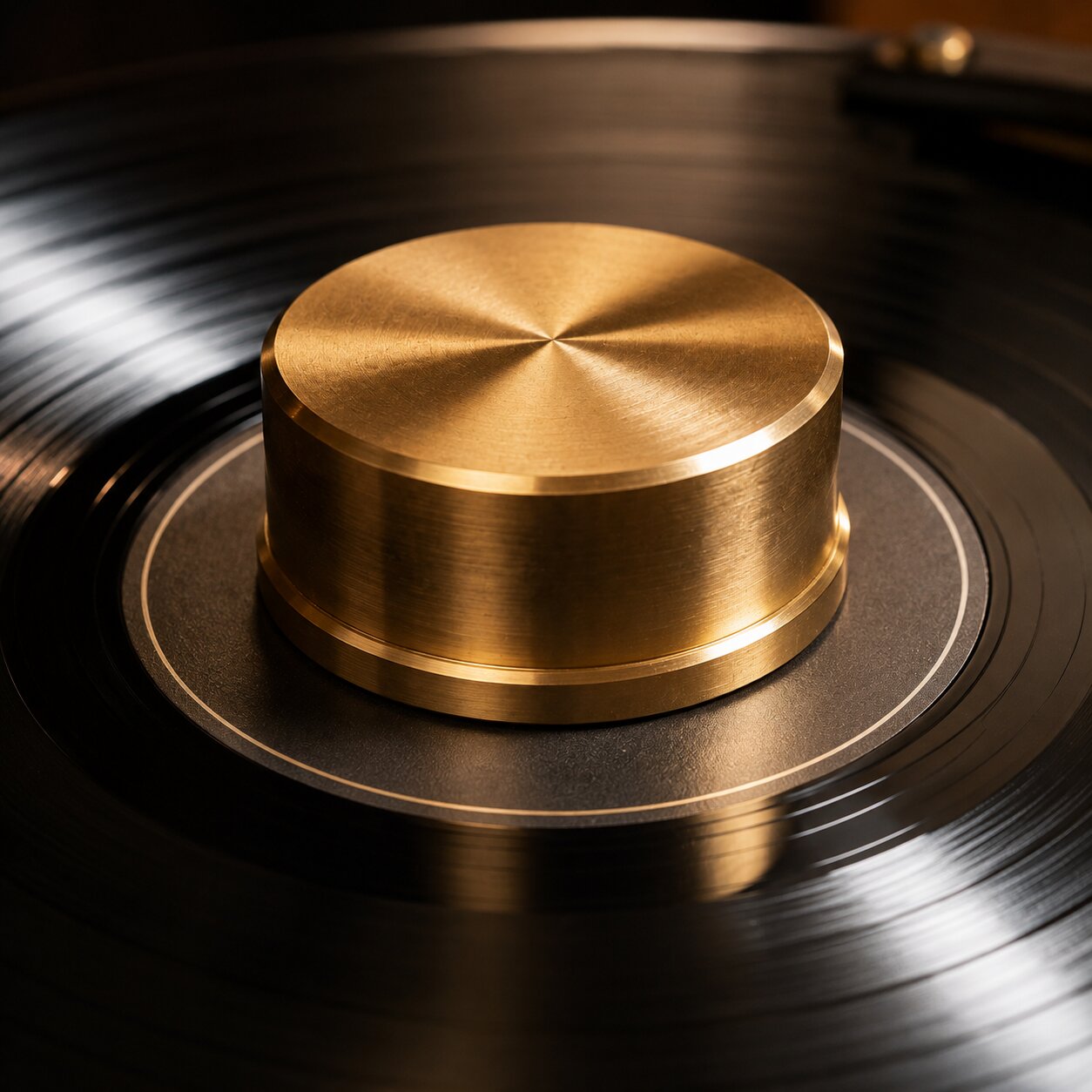
Record weights and clamps couple vinyl discs firmly to the platter surface, dampening resonance and stabilizing warped records.
| Device Type | Mechanism / Function | Primary Performance Advantage | Potential Trade-Off / Consideration |
|---|---|---|---|
| Record Weight (Heavy) | Uses gravity mass (300g–500g) to press record flat against platter. | Inexpensive, quick on/off placement; dampens platter resonance. | Heavy weight can strain delicate motor bearings on budget turntables. |
| Record Clamp (Collet) | Mechanically locks onto center spindle shaft to apply downward pressure. | Applies high clamping force with zero added bearing weight. | Takes slightly longer to screw on/off between record sides. |
| Outer Ring Clamp | Heavy metal perimeter ring that clamps record outer edges down. | Flattens severe edge warps completely across entire disc face. | Expensive ($200+); requires wide platter clearance and precise placement. |
Do They Actually Improve Sound?
Record weights and clamps provide real acoustic benefits on capable turntables:
- Platter Coupling: Pressing the vinyl disc flat against the platter mat prevents micro-vibrations generated by the stylus from reflecting back into the record disc, tightening bass response and cleaning up mid-range detail.
- Flattening Dish Warps: Placing a 13 oz record weight on a dish-warped record pushes the raised center down flat against the platter surface, preventing stylus mistracking.
- Increasing Platter Inertia: Adding mass to the platter assembly increases rotational momentum, dampening minor motor speed fluctuations (wow and flutter) and smoothing out pitch wavering.
- Damping Vinyl Resonance: Unclamped vinyl discs act like small diaphragms that vibrate in response to acoustic energy from room speakers. Clamping the disc firmly eliminates this sympathetic acoustic resonance.
- When to Avoid Heavy Weights: On entry-level belt-drive turntables with weak motors or delicate subplatter suspensions, heavy 500g weights strain motor belts and accelerate spindle bearing wear. Use a lightweight collet clamp instead.
I recommend the Record Weight Stabilizer ($26, 13 oz solid aluminum construction with a protective leather bottom pad, dampens platter resonance effectively, though too heavy for ultra-light suspended platters). For threaded spindles, the Reflex Record Clamp ($65, lightweight anodized aluminum clamp mechanism, applies high clamping force without adding bearing strain, though requiring threaded spindle shafts).
Slipmats Explained
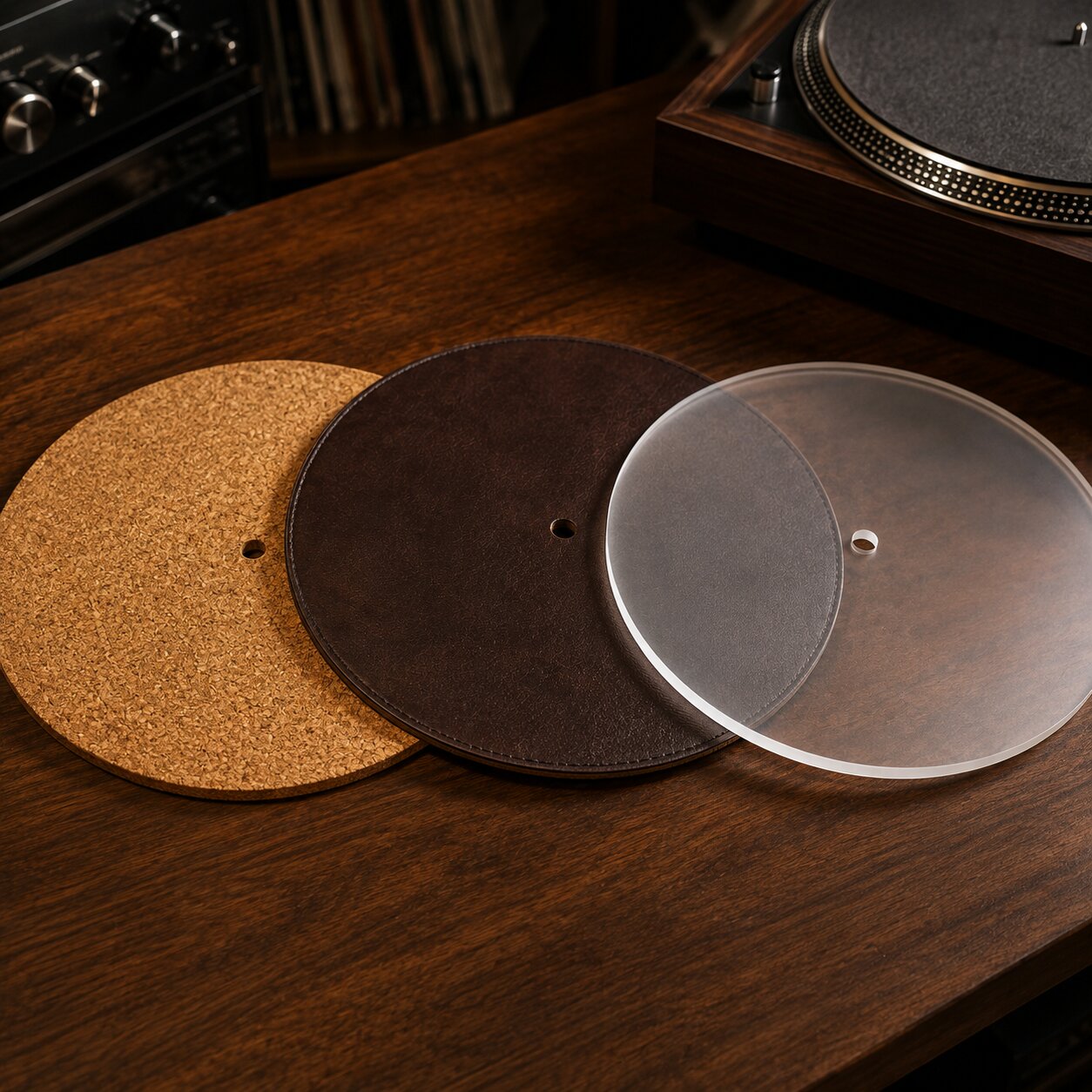
Replacing cheap factory felt mats with cork, leather, or rubber upgrades dampens platter ringing and eliminates annoying static attraction.
| Mat Material Type | Static Dissipation | Resonance Dampening | Platter Grip / Friction | Average Price Range |
|---|---|---|---|---|
| Standard Felt | Poor; high static attraction. | Minimal dampening. | Low grip; clings to vinyl. | Included Free OEM |
| Cork | Excellent anti-static. | Good high-frequency dampening. | High grip; absorbs vibration. | $15 – $25 |
| Leather / Suede | Moderate anti-static. | Outstanding bass dampening. | Superior soft surface grip. | $20 – $30 |
| Acrylic | Excellent anti-static. | Exceptional vinyl-matching density. | Direct platter contact. | $25 – $40 |
| Heavy Rubber | Good anti-static. | Extreme low-frequency damping. | High grip; heavy mass. | $20 – $35 |
Felt
Standard felt mats are supplied with most entry-level turntables.
- Pros: Inexpensive for manufacturers; ideal for DJs who need to cue and slip-scratch records.
- Cons: Generates intense static charges that cling to records when lifted off the platter, trapping floating room dust and shedding abrasive felt fibers directly into grooves.
Cork
Cork mats are one of the most effective and affordable accessories available.
- Pros: Cork’s cellular structure absorbs platter vibration, dampens motor ringing, and eliminates static cling completely.
- Cons: Low-quality cork mats can flake over time if handled roughly.
Leather
Leather mats (and suede variants) provide a luxurious, non-abrasive contact surface.
- Pros: Leather matches vinyl’s natural acoustic impedance, tightening lower bass impact while dampening mid-range harshness.
- Cons: Slightly higher price point; requires occasional cleaning with a dry microfiber cloth.
When swapping platter mats, measure the mat thickness. A 3mm cork/leather mat replacing a 1.5mm felt mat raises the record surface, which alters your tonearm’s vertical tracking angle (VTA). Adjust tonearm height accordingly to ensure the tonearm tube remains parallel to the record.
I use the Hudson Hi-Fi Cork Leather Recessed Platter Mat ($21, dual cork/leather composite construction that absorbs platter ringing while eliminating static cling, though increasing platter height by 1.5mm).
Dust Covers: Do They Actually Protect Your Turntable?
Hinged acrylic dust covers protect idle turntables from falling dust, but can introduce acoustic feedback if left raised during playback.
- Protection When Idle: An acrylic dust cover is essential for keeping ambient room dust, pet hair, and airborne grease off your platter, tonearm, and cartridge while the turntable is not in use.
- Acoustic Feedback During Playback: Playing records with a hinged dust cover raised open acts like a giant acoustic sail, catching soundwaves from room speakers and transmitting vibrations down into the tonearm.
- Dust Cover Alternatives: If your turntable lacks a hinged cover, soft fabric dust covers or lift-off clear acrylic boxes provide excellent idle protection without acoustic resonance risks.
- Best Practice: Either remove the dust cover completely during critical listening sessions, or lower it closed during playback to shield the tonearm from room air currents.
I recommend the Hudson Hi-Fi Acrylic Turntable Dust Cover ($49, clear rigid acrylic protection against ambient dust, though requiring adequate rear shelf clearance when tilting open).
What’s Marketing vs. What Helps
Separating essential performance tools from audiophile snake-oil prevents wasting your audio budget.
| Accessory Category | Genuine Performance Tool (Worth Buying) | Gimmicky Marketing Snake-Oil (Skip) |
|---|---|---|
| Setup & Calibration | Digital Stylus Force Gauge ($17); Alignment Protractor ($13). | $200 Laser Tonearm Alignment Systems. |
| Record Cleaning | Carbon Fiber Brush ($16); Anti-Static Rice Paper Sleeves ($22). | Ultrasonic Stylus Dip Tanks ($300+). |
| Resonance Control | Sorbothane Isolation Feet ($15); Record Weight ($26). | Exotic Wooden Cable Riser Blocks ($150). |
| Vibration Damping | Cork/Leather Platter Mat ($21). | Green Marker Pens for Disc Edges. |
| Power & Cabling | Double-Shielded RCA Cables ($14); Grounding Wire. | $500 Audiophile Power Cords for Turntable Motors. |
Focus your budget on essential setup tools (digital force gauges, alignment protractor (Vinyl Cartridge Alignment Protractor)s) and archival preservation items (poly-lined sleeves, carbon fiber brushes). These provide real, measurable acoustic improvements and protect your record collection.
To learn how archival sleeves protect records from shelf wear and static buildup, read our record cleaning and storage guide.
For step-by-step setup guides using these essential tools, read our turntable setup and calibration guide.
Frequently Asked Questions

Chris Pitcher
Independent vinyl collector helping music lovers discover records worth owning through reviews, recommendations and buying guides.