
How to Choose Your First Turntable: A Real Collector’s Guide
How to Choose Your First Turntable: A Real Collector’s Guide
Choosing my first real turntable was genuinely stressful. The internet is full of conflicting advice, vague reviews, and Reddit threads that devolve into audiophile arguments. I bought three decks before I landed on a setup I was happy with. This guide covers what I actually learned from those mistakes — belt-drive vs direct-drive, built-in preamps, and which budget options are worth it.
Choosing your first turntable requires evaluating drive systems (belt-drive vs. direct-drive), operation modes (manual vs. automatic), phono preamp requirements, tonearm adjustability, and component build quality. Selecting a well-built, upgradeable turntable protects your records from groove wear while delivering clear, dynamic sound.
I have seen many beginner collectors buy cheap $50 suitcase record players, only to suffer from skipping, muffled audio, and permanent vinyl damage. A bad turntable ruins records, whereas a well-calibrated entry-level turntable delivers fantastic sound, protects your vinyl investment, and lasts for years. Here is how to choose the right first turntable across every budget tier.
Belt-Drive vs. Direct-Drive
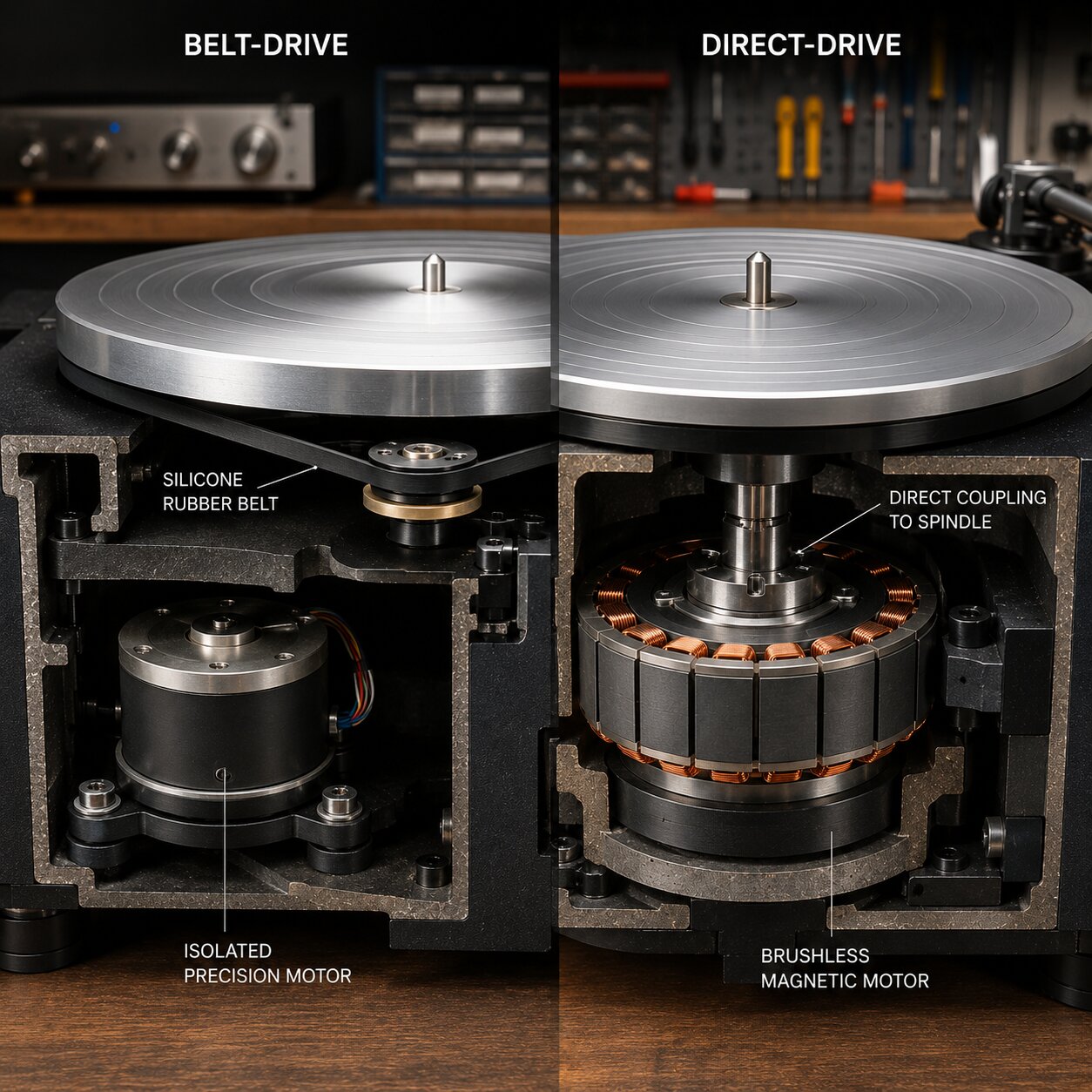
Turntables rotate their platters using either a rubber motor belt or a motor shaft mounted directly beneath the platter.
| Performance Metric | Belt-Drive Turntables | Direct-Drive Turntables |
|---|---|---|
| Motor Isolation | Excellent; rubber belt absorbs motor vibration completely. | Good; relies on electronic motor damping and heavy plinth mass. |
| Platter Torque & Startup | Lower torque; takes 2–3 seconds to reach full speed. | High torque; reaches full operating speed almost instantaneously. |
| Speed Consistency | Excellent, though belts stretch and require replacement over years. | Quartz-locked precision speed stability with zero belt wear. |
| Primary Target Use | Home hi-fi listening and audiophile entry decks. | DJ playback, back-cueing, and robust daily hi-fi listening. |
| Average Price Point | $150 – $1,000+ | $250 – $1,500+ |
Belt-Drive Turntables use an offset motor connected to the subplatter or platter via an elastic rubber belt. The belt acts as a physical shock absorber, preventing motor noise and mechanical rumble from transferring into the platter, tonearm, and stylus. They are ideal for home hi-fi listening, though belts stretch over time and require replacement every few years.
Direct-Drive Turntables mount the platter directly onto the motor spindle. They offer instant startup torque, quartz-locked speed accuracy, and extreme durability. While originally favored by DJs for back-cueing and slip-scratching, modern coreless direct-drive decks (like Technics and Audio-Technica models) eliminate motor cogging and are widely used in home audiophile setups.
Automatic vs. Manual Operation
Operation modes dictate how the tonearm lowers onto and lifts off the record surface.
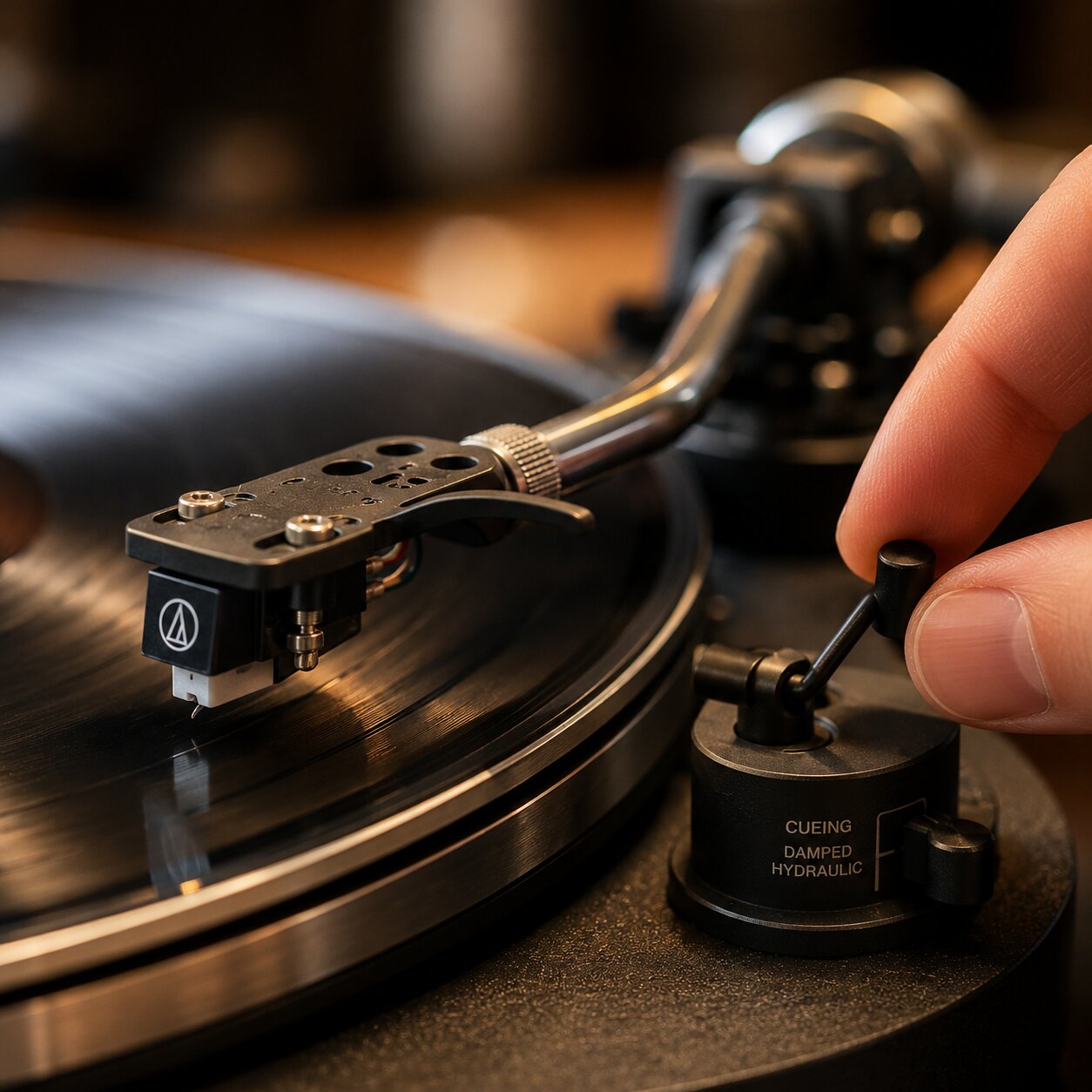
- Manual Turntables: You cue the tonearm over the lead-in groove manually and lower it using a damped cueing lever. At the end of the album side, you must manually lift the tonearm yourself. Advantage: Simple mechanical design with fewer internal gears, leaving more budget for high-quality tonearm bearings, rigid plinths, and isolated power supplies.
- Automatic Turntables: You press a start button, and the turntable automatically lifts the tonearm, moves it over the lead-in groove, lowers it, and returns the tonearm to its rest post when the side finishes. Advantage: Convenient and safe against manual hand jitter.
- Semi-Automatic / Auto-Return: You lower the tonearm manually at the start, but the turntable automatically lifts the arm and shuts off the motor at the end of the album side.
For beginners who worry about falling asleep or leaving a playing turntable spinning in the lead-out groove overnight, an automatic or auto-return model provides essential peace of mind.
Do You Need a Phono Preamp?
Every vinyl playback setup requires a phono preamp (phono stage) to boost the cartridge’s faint millivolt signal to line-level and apply the RIAA equalization curve.
Before buying your first turntable, check how your system handles phono amplification:
- Turntables with Built-in Preamps: Include a rear switch labeled “PHONO / LINE.” Set to “LINE,” you can plug the turntable directly into active powered speakers or AUX inputs on any stereo receiver.
- Turntables Without Built-in Preamps: Output raw phono signals. You must connect them to an external phono preamp or an amplifier with a dedicated “PHONO” input.
If your budget allows, buying a turntable with a switchable built-in preamp allows you to start simply today while keeping the option to upgrade to an external phono preamp later. To learn how preamps fit into your signal path, read our guide on building your vinyl signal chain.
What to Look for at Each Budget
Knowing what features to expect across price tiers prevents overpaying for low-quality hardware:
- Under $150 (Caution Tier): Mostly suitcase players and plastic decks. Warning: Avoid players with fixed red ceramic cartridges, plastic tonearms, and no counterweights. They track at dangerously heavy weights (4g to 6g) and wear out records quickly.
- $150 to $300 (Entry Hi-Fi Tier): The sweet spot for beginners. Expect adjustable counterweights, anti-skate controls, pre-installed Moving Magnet (MM) cartridges (like the Audio-Technica AT-VM95E Cartridge)), and dense wood/MDF plinths.
- $300 to $600 (Mid-Tier Audiophile): Features heavy aluminum or acrylic platters, precision carbon-fiber tonearms, ultra-quiet motors, electronic speed switching, and superior isolation feet.
- $600+ (High-End Tier): Includes heavy cast plinths, isolated outboard motor pods, advanced tonearm adjustments (VTA, Azimuth), and audiophile Moving Coil (MC) cartridge compatibility.
Top 10 Turntables Compared
This comparison table ranks the top beginner and upgrade turntables based on build quality, features, and performance value.
| Turntable Model | Drive Type | Operation Mode | Built-in Preamp | Included Cartridge | Price | Best For |
|---|---|---|---|---|---|---|
| Audio-Technica AT-LP60X | Belt | Fully Auto | Yes (Switchable) | AT-3600L Conical | $149 | Ultra-budget plug-and-play beginners. |
| Fluance RT81+ | Belt | Auto-Stop | Yes (Switchable) | Audio-Technica VM95E | $249 | Best budget wood plinth turntable. |
| Audio-Technica AT-LP120XUSB | Direct | Manual | Yes (Switchable) | Audio-Technica VM95E | $349 | Best versatile direct-drive deck. |
| U-Turn Orbit Basic V2 | Belt | Manual | Optional Add-on | Audio-Technica White | $249 | Minimalist American-made belt drive. |
| Pro-Ject Primary E | Belt | Manual | No | Ortofon OM5e | $299 | Entry audiophile plug-and-play setup. |
| Fluance RT82 | Belt | Auto-Stop | No | Ortofon OM10 | $299 | Best sub-$300 upgradeable platform. |
| Pro-Ject Debut Carbon EVO | Belt | Manual | No | Ortofon 2M Red | $599 | Top mid-tier audiophile recommendation. |
| Rega Planar 1 | Belt | Manual | No | Rega Carbon | $595 | British minimalist audiophile design. |
| Technics SL-100C | Direct | Auto-Lift | No | Audio-Technica VM95C | $1,099 | Premium coreless direct-drive deck. |
| Pro-Ject Debut PRO | Belt | Manual | No | Sumiko Rainier | $999 | Precision aluminum-carbon tonearm deck. |
Common Mistakes When Buying a First Turntable
Avoid these four common beginner pitfalls when purchasing your first turntable:
1. Buying an all-in-one suitcase player: Suitcase players feature cheap built-in speakers mounted to the same housing as the platter. Speaker vibrations shake the needle, causing skipping, severe sibilance distortion, and permanent vinyl wear.
2. Ignoring tonearm adjustability: Buying a deck without an adjustable counterweight or anti-skate control locks you into cheap cartridges and prevents future stylus upgrades.
3. Budgeting only for the turntable: Remember to budget for speakers and amplification. A $300 turntable needs powered speakers or a receiver and passive speakers to produce sound.
4. Placing speakers on the same shelf as the turntable: Speaker vibrations transmit directly into the stylus, causing acoustic feedback loops and muddy bass. Place speakers on separate stands or isolation pads.
For step-by-step assembly and alignment instructions after unboxing, review our turntable setup and calibration guide.
What I Actually Recommend
If you are buying your first turntable today, here are my three real-world recommendations based on budget and priorities:
- Best Entry Plug-and-Play ($249): I recommend the Fluance RT81+ Vinyl Turntable) → ($249). It features a heavy dense MDF wood plinth, dampening rubber isolation feet, a built-in switchable phono preamp, auto-stop functionality, and comes pre-installed with the outstanding Audio-Technica AT-VM95E cartridge. Trade-off: The built-in preamp is basic; upgrading to an external preamp later unlocks better sound.
- Best Versatile Direct-Drive ($349): I recommend the Audio-Technica AT-LP120XUSB ($349). It offers direct-drive speed accuracy, pitch controls, 33/45/78 RPM speeds, USB digital output, and full tonearm adjustability. Trade-off: Industrial DJ-style aesthetics might not suit every living room decor.
- Best True Audiophile Deck ($599): I recommend the Pro-Ject Debut Carbon EVO ($599). Features a 8.6-inch carbon fiber tonearm, heavy damped steel platter, electronic speed switching, and an Ortofon 2M Red cartridge. Trade-off: Lacks a built-in preamp and auto-stop; requires an external phono preamp and manual cueing.
To add essential maintenance accessories like carbon fiber brush (Boundless Audio Carbon Fiber Record Brush)es and stylus force gauges to your new deck, check our guide on vinyl accessories that are actually worth buying.
Frequently Asked Questions

Chris Pitcher
Independent vinyl collector helping music lovers discover records worth owning through reviews, recommendations and buying guides.