
Record Grading Guide: How to Value Used Vinyl Realistically

Record Grading Guide: How to Value Used Vinyl Realistically
I’ve bought records graded VG+ that were basically unplayable, and records marked VG that cleaned up beautifully. Grading is subjective, but it doesn’t have to be guesswork. This guide walks through the Goldmine scale the way I actually use it — what each grade looks and sounds like in practice.
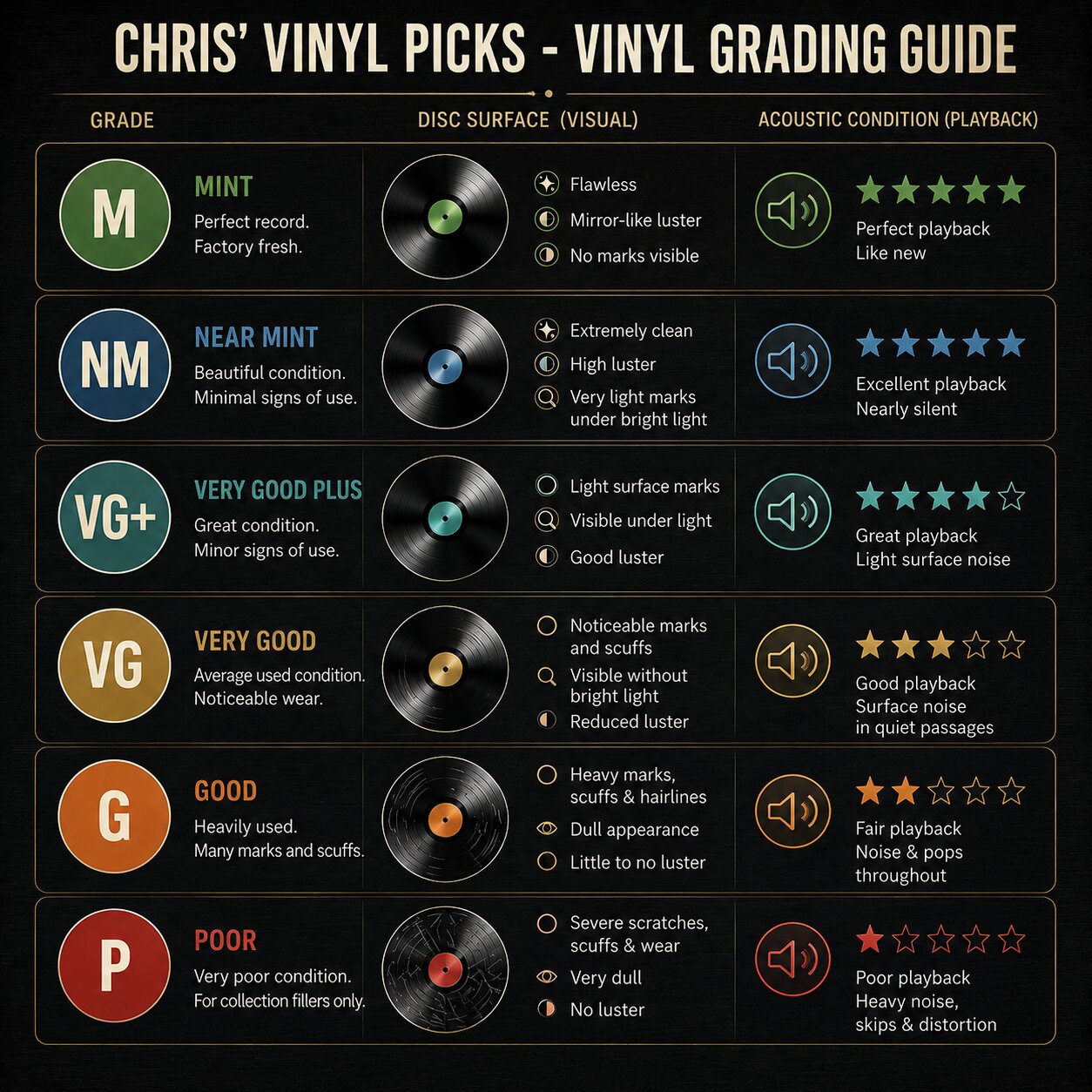
Record grading is the standardized evaluation of a vinyl record’s physical condition and acoustic playability across a scale from Mint to Poor. Accurate grading using the Goldmine standard prevents overpaying, protects buyers when purchasing secondhand vinyl online, and establishes fair market pricing based on visual inspection and audio testing.
Overgrading is the single most common frustration I encounter when buying secondhand records online. A record described as “Near Mint” that arrives covered in paper scuffs and surface noise is not just disappointing—it reflects a breakdown in grading standards. Here is the definitive collector’s guide to understanding grades, spotting hidden flaws, using inspection tools, and grading vinyl accurately.
The Standard Grading Scale
The Goldmine grading scale establishes universal condition tiers that dictate a record’s visual appeal, acoustic playability, and commercial market value.
| Grade Abbreviation | Full Condition Title | Visual Vinyl Characteristics | Acoustic Playability | Typical Market Value % |
|---|---|---|---|---|
| M | Mint | Absolutely perfect; unplayed, zero surface marks. | Flawless, zero surface noise or hiss. | 100% (Top Benchmark) |
| NM / M- | Near Mint | Opened, nearly flawless; zero visible scuffs under light. | Clean, crisp audio; silent lead-in grooves. | 80% – 90% of Mint |
| VG+ | Very Good Plus | Light signs of play; faint paper scuffs or hairlines. | Plays cleanly with minimal background noise. | 50% – 70% of Mint |
| VG | Very Good | Visible groove wear, light scratches, minor dullness. | Light surface noise in quiet passages; no skips. | 25% – 40% of Mint |
| G+ / G | Good Plus / Good | Significant wear, deep scuffs, continuous surface marks. | Persistent noise throughout playback; no skips. | 10% – 15% of Mint |
| F / P | Fair / Poor | Cracked, heavily warped, deep gouges, major damage. | Continuous skipping, repeating loops, distortion. | 0% – 5% (Filler Copy) |
Mint (M) and Near Mint (NM)
- Mint (M): A Mint record is physically perfect in every single aspect. It has never been played and is typically sealed in original factory shrink wrap. Most open records—even those played only once or twice—cannot realistically be graded Mint. In collector circles, a record is only Mint if it left the factory without a single microscopic flaw. Even sealed copies can occasionally hide factory pressing defects or edge warps beneath the shrink wrap, making true Mint records exceedingly rare.
- Near Mint (NM or M-): The practical ceiling for open, used vinyl. A Near Mint disc displays no visible surface marks, paper scuffs, or center spindle trails under direct inspection light. The center label is bright, centered, and unblemished, and audio playback is completely free of surface noise, pops, or crackle. A Near Mint record should look as if it was just purchased from a retail shop and played once with pristine care.
Very Good Plus (VG+)
- Very Good Plus (VG+): The standard benchmark grade for serious collectors. A VG+ record shows minor evidence of prior handling, such as faint paper scuffs caused by sliding in and out of paper inner sleeves, or shallow hairlines.
- Visual Surface: The vinyl retains strong original factory gloss across both sides, with no deep scratches or groove graying. The center label may display very light spindle marks from careful turntable placement.
- Acoustic Playability: These cosmetic imperfections do not affect sound quality. Audio playback remains clean, dynamic, and enjoyable, with only minor background tick or surface noise during silent lead-in grooves or track transitions.
Very Good (VG) and Below
- Very Good (VG): Shows obvious signs of frequent play and handling. The vinyl surface loses some original factory gloss and displays visible light scratches that can be felt slightly with a fingernail. During playback, surface noise, clicks, and pops are audible—especially during quiet acoustic intro tracks or track transitions—though the needle will not jump, skip, or stick in a groove loop.
- Good Plus (G+) and Good (G): Highly worn records with persistent background noise that competes directly with the music. Groove walls display heavy graying, clouding, and groove wear from uncalibrated turntables. These copies are playable but lack dynamic impact and high-frequency resolution.
- Fair (F) and Poor (P): Severely damaged discs that skip, repeat, or feature physical cracks and deep gouges. These serve strictly as temporary collection filler copies until a cleaner version is acquired.
For a full alphabetical reference of condition terms and trade abbreviations, consult The vinyl collector’s glossary (A-Z).
What VG+ Actually Means (With Photos)
Very Good Plus is the most traded—and most frequently misgraded—condition tier in the vinyl marketplace.
Visual Signs of a VG+ Record
When evaluating a record disc under direct inspection light, a genuine VG+ vinyl disc exhibits specific visual traits:
- Factory luster preserved: The vinyl surface retains strong reflectivity and original black sheen across the entire record face.
- Faint paper scuffs only: Surface marks are limited to wispy, superficial paper scuffs or ultra-fine hairlines that do not penetrate the vinyl groove walls.
- Clean center labels: Center paper labels are bright and free of writing, tears, or heavy spindle mark rings.
- Zero feelable scratches: Running your fingertip lightly across the record reveals no deep grooves or scratches that catch your fingernail.
Visual Inspection Note: Under a bright LED point light source, a VG+ record may show faint wispy sleeve traces, but the black vinyl surface reflects light clearly without cloudy patches or gray groove wear lines.
Visual Signs of a VG+ Sleeve
A VG+ album jacket displays minor shelf wear while preserving structural integrity and artwork clarity:
- Intact seams and spine: All three jacket seams (top, bottom, and spine) are solid without seam splits or tape repairs. Spine title text remains fully legible.
- Minimal corner wear: Album corners may show slight dulling or tiny dings, but no major bent folds or creasing.
- Light ring wear: Front and back artwork may display very faint circular ring wear outlines, but artwork graphics remain vibrant without paper tearing or color fading.
- Clean surfaces: Free of prominent promo punch holes, major price sticker tears, or heavy marker signatures, unless explicitly noted in the listing description.
Visual Inspection Note: A VG+ jacket sits flat and firm on a shelf, showing minor edge rubbing along the bottom seam but zero paper splits or water warping.
Sleeve Grading vs. Vinyl Grading
A record consists of two distinct physical items—the vinyl disc and the outer sleeve—which must always be graded separately.
It is common for a record to feature a flawless NM vinyl disc paired with a worn VG jacket that suffered shelf storage wear over decades. Conversely, an immaculate NM jacket might contain a heavily scratched G+ disc that was played continuously on an uncalibrated turntable.
When listing or reading record grades online, condition is represented as Vinyl Grade / Sleeve Grade (e.g., VG+ / VG indicates a Very Good Plus record inside a Very Good sleeve).
Key sleeve defects to evaluate independently include:
- Seam splits: Physical tears along jacket edges caused by vinyl discs shifting inside the sleeve during shipping. Top, bottom, and spine seams should be measured in inches if split.
- Foxing and mold: Brown spotting and paper oxidation caused by damp storage conditions in basements or attics.
- Cut-out marks: Drill holes, saw cuts, or clipped jacket corners applied by distributors to mark overstock inventory.
- Gatefold and Insert Grading: Gatefold inner panels, printed lyrics inserts, posters, and Japanese obi strips must be inspected and graded alongside the outer jacket. Missing inserts or torn obi strips reduce total sleeve grade value.
To learn how archival sleeves protect album jackets from shelf wear, read our record cleaning and storage guide.
Grading Discrepancies: Discogs vs. Seller vs. Reality
Overgrading occurs when sellers assign higher condition grades than a record’s physical state justifies to inflate sale prices.
Common Overgrading Tactics to Watch For
Online buyers must remain vigilant against common seller overgrading practices on platforms like Discogs and eBay:
- Confusing VG with VG+: Sellers frequently label worn VG records as VG+, dismissing audible surface noise and visible scratches as “normal for its age.”
- Visual grading without play testing: Relying solely on quick visual checks under weak ambient room light misses deep groove wear and pressing noise.
- Unwashed vinyl inspection: Dust and fingerprint oils mask fine hairline scratches, causing uncleaned records to appear cleaner visually than they actually sound.
- Ignoring inner-groove distortion: Failing to play test the final track near the center label, where groove packing exaggerates mistracking noise.
- Vague descriptor phrases: Phrases like “plays great for its age” or “near mint audio with minor marks” are red flags indicating the seller is attempting to excuse visual or acoustic flaws.
For strategies on navigating seller feedback ratings and filing buyer protection claims, consult our buying and selling vinyl guide.
Understanding the Goldmine Grading Standard
While Goldmine is the dominant grading system in North America, European sellers frequently use the UK Record Collector grading convention.
The Goldmine grading standard was originally established in the 1970s by Goldmine magazine (pioneered by record pricing authority Tim Neely) to create a universal framework for mail-order record collectors. It remains the official grading standard used by Discogs.
US (Goldmine) vs. UK/European Grading Conventions
| Condition Level | US Goldmine Standard Grade | UK Record Collector Standard Grade | Practical Condition Comparison |
|---|---|---|---|
| Flawless / New | Mint (M) | Mint (M) | Unplayed, factory perfect condition in both systems. |
| Top Used Copy | Near Mint (NM) | Excellent (EX) | UK EX matches US NM / high VG+; allows minor handling marks. |
| Very Good Copy | Very Good Plus (VG+) | Very Good (VG) | UK VG allows moderate scuffs, corresponding roughly to US VG+ / VG. |
| Worn Copy | Very Good (VG) | Good (G) | UK Good represents significant wear; equivalent to US VG / G+. |
| Damaged Copy | Good Plus (G+) | Fair (F) | Heavily worn vinyl with heavy background noise. |
Understanding these regional differences prevents misunderstandings when importing vinyl from UK or European sellers. A record graded Excellent (EX) by a British seller is equivalent to a strong US VG+ or Near Mint copy.
Tools for Grading (Loupes, Lighting)
Accurate visual grading requires dedicated high-intensity lighting and magnification tools to inspect groove walls effectively.
Professional grading tools worth adding to your workbench:
- Raking Light Source: A bright LED flashlight held at a low 15-degree angle across the vinyl disc face (raking light) illuminates microscopic hairline scratches, paper scuffs, and pressing non-fill defects that remain invisible under overhead ceiling lights. I recommend using the Anker Rechargeable Pocket LED Inspection Light ($19, delivers an intense narrow beam ideal for raking light inspection, though the metal casing gets warm during extended use).
- Grading Magnifier / Loupe: A 10x to 30x optical loupe allows you to inspect deep groove scratches, center spindle wear, and stylus tip shape. I use the Jarlink 30X 60X Illuminated Jewelers Loupe ($12, features dual LED magnifiers that reveal hairline scratches and groove wear, though requiring close eye placement near the lens).
- UV Light Inspection: Blacklight UV flashlights reveal water restoration repairs, hidden sleeve glue repairs, and mold spore foxing on album jackets that are invisible under standard white light.
To learn how matrix codes cut into dead wax indicate specific pressing origins under magnification, read our [pressing identification guide.
How to Grade a Record Before Buying Secondhand
Following a systematic inspection checklist ensures you identify hidden flaws before completing a secondhand record purchase.
In-Person Grading Checklist
When evaluating records at record stores, flea markets, or estate sales, follow these sequential steps:
1. Pull vinyl completely from the sleeve: Hold the record by its outer edges and center label using clean hands; never touch playing grooves directly with your fingers.
2. Inspect under direct raking light: Tilt the disc beneath a bright point light source, checking both Side A and Side B for scratches, warp curves, or dull graying groove wear.
3. Run a light fingernail check: Gently feel across any visible scratch line. If your fingernail catches or clicks against the groove, the scratch will produce an audible pop or skip during playback.
4. Examine center spindle hole and label: Check for heavy spindle mark trails, label tears, or center hole enlargement caused by rough handling.
5. Inspect the jacket and inner sleeve: Check jacket seams for splits, ring wear, moisture stains, and spine damage. Verify whether the original printed inner sleeve or an archival poly-lined sleeve is included.
6. Request an in-store play test: Most reputable record shops provide a listening station. Play test the lead-in groove and the inner tracks closest to the label to evaluate background surface noise.
Grading From Photos/Listings Only
When purchasing vinyl online without physical inspection:
- Request raking light photos: Ask the seller for clear photos taken under direct point light at an angle, rather than flat overhead scans.
- Ask for play grading confirmation: Verify whether the seller visually graded the disc under a bulb or actually listened to audio playback on a calibrated turntable.
- Check seller feedback history: Review seller feedback scores specifically filtering for complaints regarding overgrading, inadequate packaging, or hidden seam splits.
- Review return policies: Ensure the seller honors returns or partial refunds if a record arrives in condition below the stated grade.
Frequently Asked Questions

Chris Pitcher
Independent vinyl collector helping music lovers discover records worth owning through reviews, recommendations and buying guides.