
How to Identify Vinyl Pressings: Matrix Etchings & Dead Wax
How to Identify Vinyl Pressings: Matrix Etchings & Dead Wax
I got obsessed with identifying pressings after I accidentally bought a later repress thinking it was an original. Learning to read dead wax etchings changed how I shop entirely. This guide covers matrix codes, pressing plant stamps, and how to use Discogs to verify what you’ve actually got.
Identifying a vinyl record pressing requires reading matrix etchings in the dead wax, recognizing label design variations across release eras, decoding country manufacturing marks, and evaluating vinyl composition. Accurately pinpointing a record’s country, year, plant, and mastering engineer distinguishes valuable original first pressings from common reissues.
Pressing identification is where vinyl collecting transforms from a casual hobby into real expertise. Two copies of an album can share identical jacket artwork, yet one is a muddy $5 reissue cut from a compressed digital tape, while the other is a $200 original first pressing mastered directly from master tapes by Robert Ludwig. Here is how to decode matrix codes, label variations, country characteristics, and pressing variants step by step.
Reading Matrix / Runout Etchings
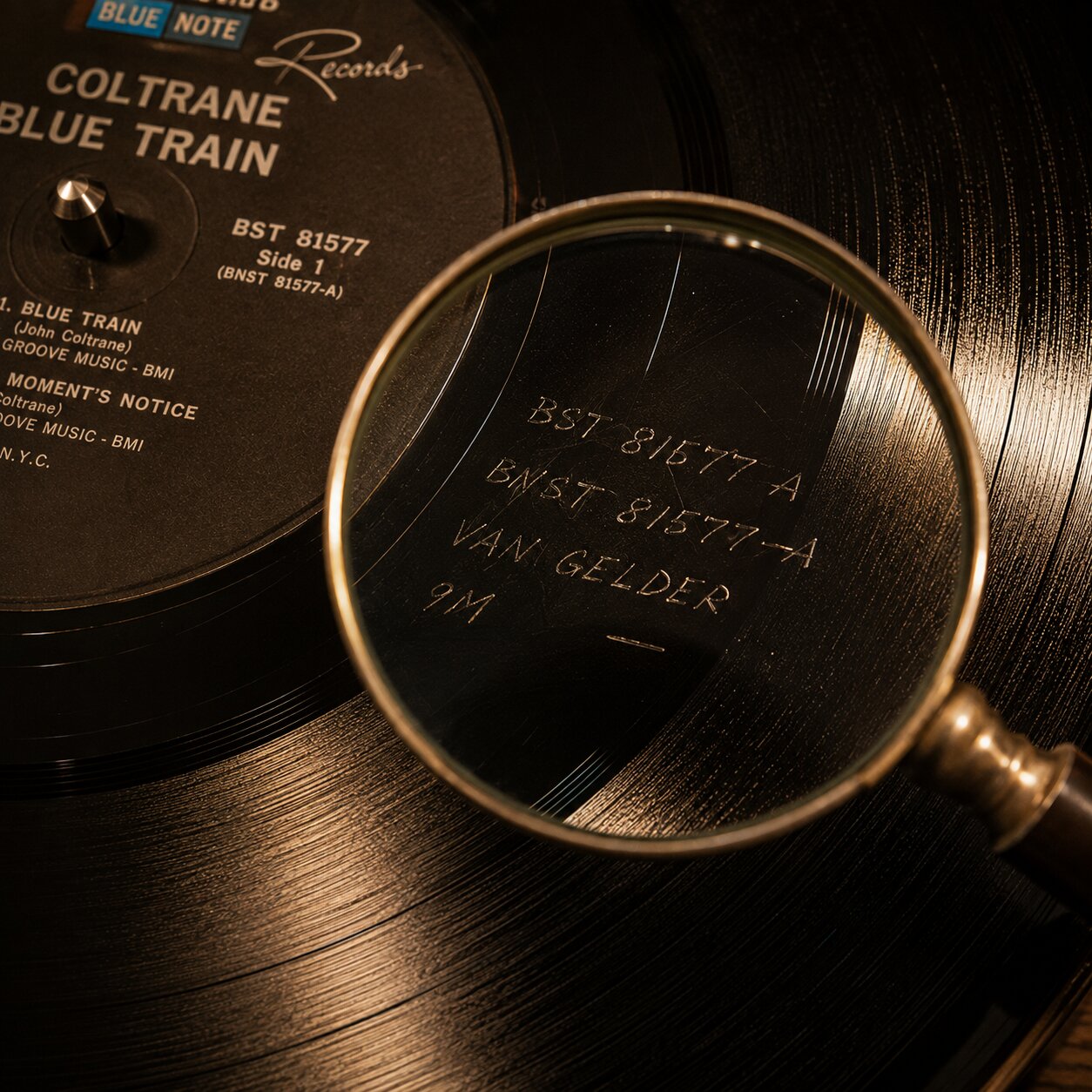
Runout etchings etched into the dead wax provide the definitive forensic identity of any record pressing.

What the Numbers and Letters Mean
The ungrooved vinyl ring between the final music track and the paper center label—known as the dead wax or runout groove—contains etched or stamped alphanumeric codes applied by the mastering engineer during lacquer cutting.
A standard matrix code string follows a structured formula:
`[Catalog Number] – [Side Letter] – [Lacquer Cut / Take Number] – [Pressing Plant Mark]`
For example, a dead wax etching reading `SD 7208 A1 ST-A-712285-A RL` breaks down as follows:
- SD 7208: The record label’s original catalog number assigned to the album release.
- A1: Indicates Side A, first lacquer cut take.
- ST-A-712285: Atlantic Records internal master tape reel designation.
- RL: The personal signature stamp of legendary mastering engineer Robert Ludwig.
Stamped text vs. handwritten etchings:
- Stamped text: Applied using metal punch stamps at major commercial mastering facilities (e.g., Columbia, RCA, Capitol, EMI).
- Hand-etched text: Scratched manually with a scribe stylus by independent mastering engineers, often accompanied by playful slogans or personal initials.
Pressing plant symbols etched or stamped in dead wax identify where the vinyl was physically pressed:
- SRC Logo (Specialty Records Corporation): A stamped large “S” with an “R” and “C” nested inside, indicating pressing at Specialty in Olyphant, PA.
- Monarch “MR” / Delta (∆): A stamped “MR” inside a circle, often accompanied by handwritten “∆” (delta) numbers, identifying Monarch Record Mfg. in Los Angeles.
- Columbia Plant Identifiers: Small stamped “P” (Pitman, NJ), “T” (Terre Haute, IN), or “S” / “CSM” (Santa Maria, CA) indicate Columbia’s regional pressing facilities.
- Allied Record Company (a): A stamped lower-case “a” or Q-shaped logo designating Allied pressings.
- Customatrix “o”: A small stamped circle or “o” indicating metal plating work performed by Customatrix.
Mastering Engineer Signatures and Codes
Identifying the mastering engineer’s dead wax signature is often the fastest way to verify an audiophile-grade pressing:
- RL (Robert Ludwig): Famous for cutting the legendary “RL Led Zeppelin II” with full dynamic range. His cuts are renowned for deep bass punch, explosive dynamics, and wide frequency response.
- RVG / Rudy Van Gelder: Stamped “RVG” or “VAN GELDER” in the dead wax of iconic Blue Note, Impulse\!, and Prestige jazz records, indicating mastering by Rudy Van Gelder on his custom Scully cutting lathe.
- Porky / Pecko Duck (George Peckham): Legendary UK cutting engineer who etched witty slogans like “A Porky Prime Cut” or “Pecko” into classic British rock pressings for Led Zeppelin, Genesis, and Joy Division.
- BG (Bernie Grundman): Hand-etched “BG” indicating mastering by Bernie Grundman, known for spacious soundstaging, natural vocal air, and liquid mid-range resolution.
- Sterling / Masterdisk: Corporate mastering studio stamps indicating high-quality lacquers cut at Sterling Sound or Masterdisk facilities in New York.
- TML (The Mastering Lab): Stamped “TML-M” (Master), “TML-S” (Slave), or “TML-X” indicating cuts from Doug Sax’s famous custom tube-driven cutting lathe in Los Angeles.
- Wally (Wally Traugott): Hand-etched “Wally” on Capitol releases, prized for crisp high-frequency detail and balanced stereo separation.
To read faint or shallow dead wax etchings under low light, I recommend using the Jarlink 30X 60X Illuminated Jewelers Loupe ($12, dual LED magnification reveals shallow hand-etched initials, though requiring close eye positioning). For full terminology definitions, check The vinyl collector’s glossary (A-Z).
First Pressing vs. Reissue: What Actually Changes
Distinguishing original first pressings from subsequent reissues involves evaluating sound quality differences and collector market valuations.
Sound Differences
Original first pressings were cut directly from fresh, first-generation analog master tapes when the tapes were brand new and magnetic oxide shedding had not occurred. the first stampers derived from those early lacquers pressed records before stamper groove wear degraded high-frequency detail.
Subsequent reissues produced decades later often rely on second-generation tape safety copies, digital remasters, or worn stampers. In worst-case scenarios during the 1970s oil crisis, labels recycled returned vinyl, introducing regrind paper and impurities into PVC pellets that increased surface noise.
Famous Pressing Case Studies:
- Led Zeppelin II (Hot Mix by Robert Ludwig): Released in 1969 with RL dead wax, this original first pressing was mastered so dynamically that cheap record player needles skipped. Atlantic recalled it and had it re-cut with compressed dynamics. The original RL cut remains a legendary $300+ grail.
- Pink Floyd \- The Dark Side of the Moon (Solid Blue Triangle): Original 1973 UK first pressings feature a solid blue prism triangle on the center label. Subsequent pressings switched to an outlined blue triangle, with original solid blue copies commanding triple the price.
- Miles Davis \- Kind of Blue (Speed Error Correction): Original 1959 Columbia pressings contained a minor tape machine speed error on Side 1, resulting in a slightly sharp pitch. Modern reissues cut from corrected master tapes fixed this speed error.
However, not all first pressings sound superior. Modern audiophile reissues cut from original analog tapes by specialized reissue labels (e.g., Analogue Productions, Mobile Fidelity Sound Lab, Tone Poet) frequently outshine original commercial pressings thanks to modern silent vinyl formulas and precision cutting lathes.
Value Differences
Commercial market value drops sharply as a record moves from original first pressing status to later reissues:
- True Original First Pressing: Commands 100% of peak collector market value due to historical significance, rarity, and original artwork stock.
- Early Repress (Same Year / Era): Commands 50% to 70% of first pressing value; shares identical sound quality if cut from original lacquers.
- Standard Budget Reissue (1970s / 1980s): Commands 15% to 30% of original value; functional for casual listening but lacks collector prestige.
- Modern Mass-Market Reissue: Sells for standard retail pricing ($25 – $35); value remains tied to retail availability rather than collector scarcity.
To learn how to grade vinyl condition when evaluating first pressing values, read our record grading guide.
Dating a Record Using Label Design
Record labels altered center label graphics, addresses, rim text, and logos over time, providing clear visual benchmarks for dating pressings.
US Label Design Eras (e.g. Columbia, Capitol)
Major US record labels changed center label graphics every few years, creating reliable visual timelines:
Columbia Records Label Eras
- 6-Eye Label (1955–1962): Features six Columbia eye logos around the label perimeter; denotes desirable early mono and 6-eye stereo jazz and classical releases.
- 2-Eye Label (1962–1970): Features two eye logos at the 3 o’clock and 9 o’clock positions. Black text at the bottom changed from “Guaranteed High Fidelity” (mono) to “360 Sound Stereo” in white text (1963–1967) and later red text (1967–1970).
- Red Ring / All-Around Eye Label (1970s–1980s): Yellow Columbia logos encircle the outer perimeter of a red label background.
Capitol Records Label Eras
- Turquoise Label (1950–1957): Dark turquoise label with silver text used during the early LP era.
- Black Rainbow / Colorband Label (1958–1969): Iconic black label encircled by a rainbow colorband, featuring the Capitol dome logo at 12 o’clock (1958–1962) or left at 9 o’clock (1962–1969).
- Green Target Label (1969–1971): Lime green background featuring a large circular Capitol target logo.
- Orange Label (1972–1978): Bright orange background with “Capitol” printed in bottom perimeter text.
Blue Note Records Label Eras
- Lexington Ave (1951–1957): Address reads “767 Lexington Ave NYC” on deep groove center labels; holy grail jazz pressings.
- 47 West 63rd (1957–1962): Address reads “47 West 63rd NYC,” featuring deep groove pressings cut by Rudy Van Gelder.
- New York USA (1962–1966): Address reads “Blue Note Records Inc \- New York USA.”
- Liberty Records / United Artists (1966–1979): Reissue eras following Blue Note’s sale to corporate labels.
UK Label Design Eras
UK record labels featured unique manufacturing details and legal rim text:
- Decca “Unboxed” vs. “Boxed” Logo: Early 1960s Decca pressings feature an “unboxed” open script logo. Around 1969, Decca enclosed the logo inside a rectangular box, marking a clear boundary between original pressings and 1970s reissues.
- EMI / Parlophone Gramophone Rim Text: Original 1960s Beatles LPs feature rim text beginning with “The Gramophone Co. Ltd.” In 1973, this text was updated to “EMI Records Ltd.,” instantly identifying post-1973 reissues.
- Flipback Jackets: British album jackets from the 1950s and 1960s feature paper flaps folded over the rear cardboard cover (“flipback seams”) laminated with glossy front coatings.
Identifying Country of Origin
Records manufactured in different countries exhibit distinct vinyl weights, mastering characteristics, and sleeve construction.
| Country of Origin | Vinyl Disc Characteristics | Audio / Mastering Style | Jacket & Artwork Construction |
|---|---|---|---|
| United States (US) | Heavy rigid vinyl (1950s–60s); thinner flex vinyl during 1970s oil crisis. | Punchy bass, strong dynamic forwardness, cut loud for radio play. | Heavy cardboard paste-over jackets (“tip-on” sleeves). |
| United Kingdom (UK) | High-grade silent PVC, flat profile, deep groove center labels (pre-1968). | Warm natural mid-range, spacious balance, non-fatiguing top end. | Lightweight cardstock with laminated glossy front flipback seams. |
| Germany | Premium virgin vinyl, quiet surface noise, precise pressing consistency. | Clinical accuracy, extended high-frequency clarity, ultra-low rumble. | Heavy cardstock, non-laminated matte or semi-gloss finishes. |
| Japan | 100% virgin vinyl (Super Vinyl), dead silent noise floor, immaculate finish. | Crystal-clear treble, detailed imaging; can sound lean on bass. | Heavy rigid cardboard, includes Obi strip, Japanese lyric insert. |
| Canada | Thick vinyl pressings, often pressed at Quality Records (Q mark). | Similar to US mastering; uses US metal mothers or local cuts. | Sturdy unlaminated paper sleeves, unique Canadian catalog prefixes. |
| Netherlands / Holland | High quality Philips / CBS pressing plants, quiet vinyl surfaces. | Smooth neutral tonal balance, excellent classical mastering. | Glossy cardstock jackets, European catalog conventions. |
US, UK, German and Japanese Pressing Differences
- US Pressings: Known for raw dynamic energy and punchy bass, cut loud for American radio play. US jackets used heavy board stock where printed paper sheets were pasted over cardboard blanks (“tip-on jackets”).
- UK Pressings: Revered for rich mid-range warmth and natural vocal realism, pressing on superior quiet vinyl formulas using EMI and Decca mastering equipment.
- German Pressings: Famous for pristine engineering tolerances and silent surface noise, making German pressings highly sought after for classical and progressive rock albums.
- Japanese Pressings: Considered the gold standard for vinyl manufacturing purity. Japanese pressing plants used virgin vinyl free of recycled regrind, resulting in dead-silent backgrounds.
Identifying Promo and Test Pressings
Promotional copies and factory test pressings represent limited pre-release manufacturing runs valued by serious collectors.
- Test Pressings: The absolute first physical records struck from newly cut stampers, pressed in small batches (5 to 20 copies) for artist and producer review. They feature plain white paper center labels with handwritten catalog numbers, dates, or rubber-stamped plant marks.
- White Label Promos (WLP): Commercial pre-release copies manufactured for radio stations and music critics. They feature custom white center labels stating “Demonstration Not For Sale” or “Promotional Copy.” Because WLPs were struck from fresh first-edition stampers, they offer exceptional audio quality.
- Gold Foil Stamp / Promo Cuts: Standard commercial pressings converted into promo copies by adding a gold foil warning stamp over the jacket artwork, or punching a small hole/corner cut through the sleeve. While these contain standard commercial vinyl, they verify early pressing distribution.
Colored Vinyl and Special Editions: Worth the Premium?
Colored vinyl, picture discs, and limited box sets command high retail prices, but their audio performance varies significantly.
- Standard Black Vinyl: Contains carbon black additive, which strengthens the PVC plastic matrix, reduces static accumulation, and provides lower surface noise over repeated plays.
- Colored Vinyl (Solid / Clear / Splatter): Modern colored vinyl uses high-purity clear PVC mixed with color dyes. High-quality modern colored pressings match black vinyl in audio fidelity, though multi-color “splatter” or “liquid-filled” variants can introduce light surface ticking at color transitions.
- Picture Discs: Manufactured by sandwiching a paper graphic picture between two thin layers of clear vinyl. Picture discs feature shallow groove depths that result in noticeable background hiss, surface rumble, and reduced dynamic range. They are best treated as display collectibles rather than high-fidelity listening copies.
- 180g / 200g Heavyweight Vinyl: Thicker vinyl discs resist warping and sit firmer on turntable platters. However, weight alone does not dictate sound quality—a 180g record cut from a compressed digital file will sound inferior to a thin 120g original pressing cut from analog master tapes.
Japanese Pressings 101
Japanese vinyl pressings are renowned worldwide for dead-silent surface noise, immaculate packaging, and unique collector accessories.
Toshiba-Capitol Pressings Explained
From the late 1950s through the 1970s, Toshiba Musical Industries pressed records using a proprietary dark red translucent vinyl formula known as Everclean Red Vinyl.
- Everclean Red Vinyl: Formulated with an anti-static compound designed to prevent dust accumulation in dusty Japanese homes.
- How to Identify: When held up to a strong light source, the record glows a deep translucent ruby red color.
- Audio Quality: Highly prized by collectors for dead-silent noise floors and exceptional durability.
Reading Obi Strips
An Obi strip (derived from the Japanese word for a kimono sash) is a paper band wrapped vertically around the left spine of imported Japanese records.
- Purpose: Provides Japanese translations of album titles, track listings, artist biographies, and retail pricing for Japanese consumers.
- Collector Value: Because Japanese consumers frequently discarded Obi strips after purchase, surviving records with original, undamaged Obi strips command a 30% to 100% price premium over copies lacking the paper sash.
What Is a Mihonban (Promo) Pressing?
A Mihonban (見本盤) is an official Japanese promotional pressing distributed to radio stations and reviewers prior to public release.
- Identification: Japanese promo records feature white center labels instead of standard commercial label artwork, printed with the Japanese characters 見本盤 (Mihonban) or 見本品 (Mihonhin).
- Collector Value: Highly coveted by audiophiles because Mihonban pressings were struck from pristine first-mother stampers, delivering the absolute cleanest sound achievable from Japanese mastering.
Notable Japanese Reissue Series:
- King Record Blue Note “Masterpiece” Series (1977–1983): Pressed by King Record Co., these are legendary for matching original Rudy Van Gelder Blue Note pressings in dynamic punch while offering dead-silent Japanese virgin vinyl.
- CBS/Sony 30AP Series: Half-speed mastered audiophile reissues featuring extended high-frequency extension and heavy cardstock sleeves.
For pricing guide books detailing pressing values across international variants, I recommend referencing the Record Album Price Guide ($28, comprehensive physical reference guide for catalog numbers and valuations, though secondary market prices shift faster online).
To learn how to sell or buy rare Japanese pressings safely on Discogs, consult our buying and selling vinyl guide.
Frequently Asked Questions

Chris Pitcher
Independent vinyl collector helping music lovers discover records worth owning through reviews, recommendations and buying guides.