
Building a Great Vinyl Signal Chain: Preamps, Amps & Speakers
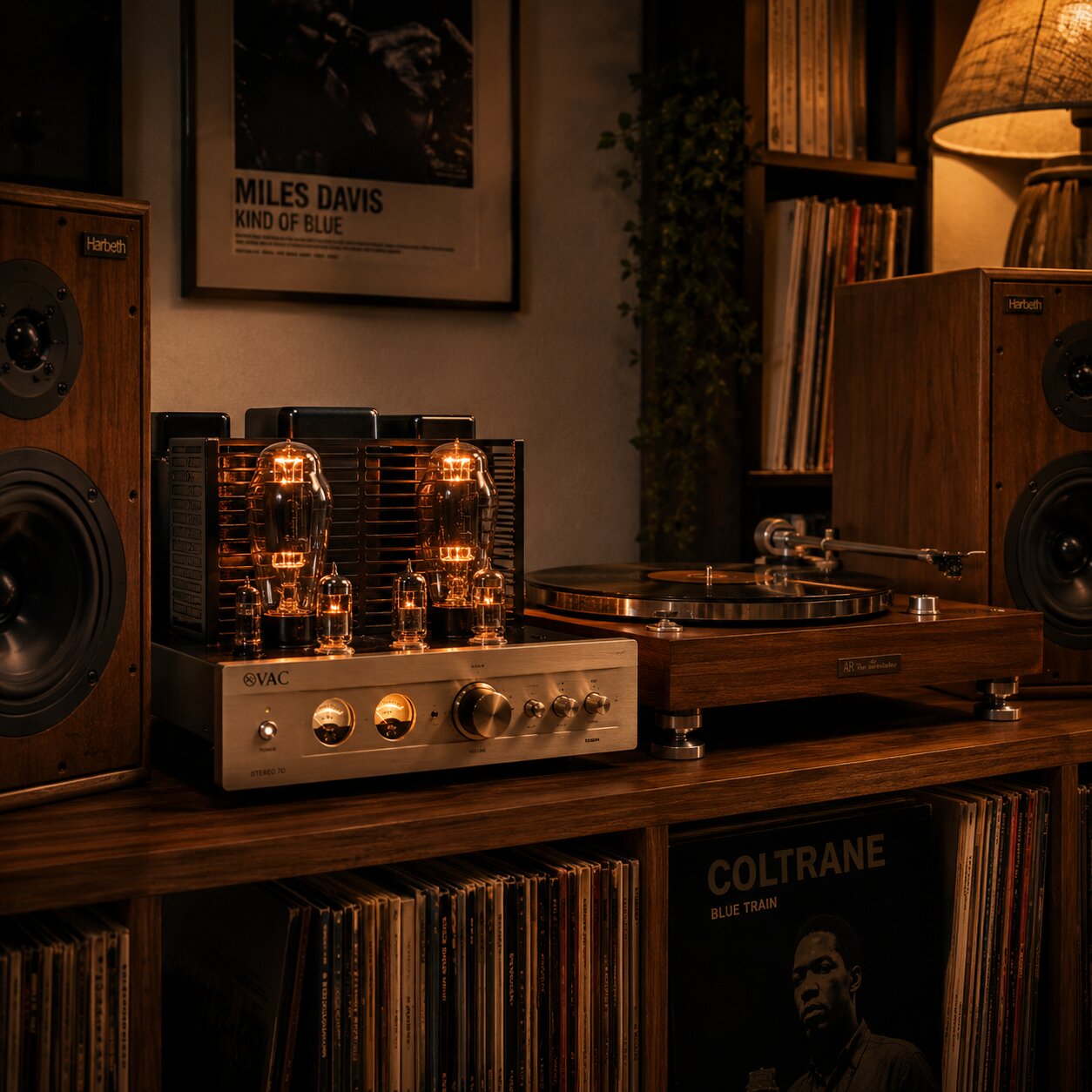
Building a Great Vinyl Signal Chain: Preamps, Amps & Speakers
The signal chain is where most people lose money buying things they don’t need. I’ve gone through three phono preamps and two sets of speakers before settling on a setup I genuinely love. This guide explains how I built it, what I’d skip in hindsight, and how to match components without overspending.
A vinyl signal chain routes tiny electrical voltages from a turntable through a phono preamp, an amplifier, and into stereo speakers. Understanding component roles, identifying built-in preamps, choosing between active and passive speakers, and selecting matching amplification ensures clean audio reproduction without hum, distortion, or signal loss.
I have seen many new collectors buy a quality turntable, plug it directly into a standard line input or Bluetooth speaker, and wonder why the audio sounds whisper-quiet and tinny. Vinyl requires a specific signal path to sound right. Here is how to assemble every link in your playback chain for maximum audio clarity across any budget.
Do You Need a Phono Preamp?
Unlike digital audio sources (like CD players or streaming DACs) that output a strong 2.0-volt line-level signal, a phono cartridge generates a microscopic electrical signal ranging from just 0.2 mV (Moving Coil) to 5.0 mV (Moving Magnet).

A phono preamp (also called a phono stage) performs two essential jobs in the signal chain:
1. Voltage amplification: It boosts the tiny millivolt phono signal up to a standardized line-level signal (roughly 300 to 500 times voltage gain) so power amplifiers can drive speaker cones.
2. RIAA equalization restoration: During vinyl mastering, bass frequencies are reduced and treble frequencies are boosted to fit physical grooves onto disc surfaces. The phono preamp applies the exact inverse RIAA equalization curve, boosting bass and cutting treble to restore natural tonal balance.
Before the Recording Industry Association of America standardized the RIAA curve in 1954, record labels used competing equalization curves (such as NAB or Columbia curves). Modern phono preamps adhere to strict RIAA tolerances to ensure balanced bass weight and natural treble reproduction. Without a phono preamp somewhere in your signal chain, audio output will sound thin, lacking bass, and barely audible even with your amplifier volume turned up completely.
How to Tell If Yours Has One Built In
Before buying a dedicated phono stage, check if your existing hardware already includes a built-in phono preamp:
- Check your turntable rear panel: Look for a toggle switch labeled PHONO / LINE. If this switch exists, your turntable has an internal phono preamp. When set to “LINE,” the internal preamp is active; when set to “PHONO,” the internal preamp is bypassed.
- Check your receiver or amplifier inputs: Inspect the rear input jacks. If there is a dedicated pair of RCA jacks labeled PHONO alongside a thumb-screw grounding lug, your amplifier contains an integrated phono stage.
- Check your powered speakers: Some powered stereo speakers feature a dedicated RCA input with an adjacent “PHONO / LINE” selector switch.
If neither your turntable, receiver, nor powered speakers feature a phono input or switch, you must purchase a standalone external phono preamp. For help evaluating turntable options with or without built-in preamps, see our first turntable guide.
Built-In vs. External Preamps
Choosing between built-in and external phono preamps involves balancing spatial convenience against dynamic resolution and signal-to-noise performance.
| Feature / Metric | Built-In Phono Preamp (Turntable/Amp) | Standalone External Phono Preamp |
|---|---|---|
| Cable Management | Minimal clutter; integrated internally inside chassis. | Requires extra pair of RCA interconnect cables and power brick. |
| Circuit Quality | Basic mass-market op-amps; shared power supply. | High-grade discrete capacitors, isolated power supply. |
| Signal-to-Noise Ratio | Higher background hiss and motor hum interference. | Ultra-quiet background; black noise floor. |
| RIAA Accuracy | Approximate frequency curve compliance (+/- 1.5 dB). | Precision frequency curve compliance (+/- 0.2 dB). |
| Cartridge Flexibility | Fixed 40 dB gain; Moving Magnet (MM) support only. | Configurable gain (40–70 dB) and load switches for MM & MC. |
| Price Point | Included free in turntable/receiver purchase price. | $65 – $500+ |
When an External Preamp Is Worth It
Upgrading from a built-in phono stage to a quality external phono preamp is one of the most cost-effective audio upgrades available. An external preamp is worth the investment when:
- You upgrade to a better cartridge: Advanced elliptical and microline cartridges reveal delicate detail that cheap internal preamps compress. To select an upgraded transducer, read our cartridges and styli guide.
- You hear background hiss or motor hum: External preamps feature shielded metal enclosures and separate power supplies that eliminate internal AC electrical interference.
- You want to tune high-frequency capacitance: External preamps allow you to match input capacitance (e.g., 100pF vs 200pF) to your cartridge manufacturer’s specifications, preventing harsh treble peaks.
- You want to play Moving Coil (MC) cartridges: Almost all built-in preamps only support high-output MM cartridges. External units offer adjustable gain and resistive loading for low-output MC designs.
Recommended external phono preamps:
- Art DJPRE II ($65): The best budget external preamp available. Features adjustable input gain trim and switchable input capacitance (100pF/200pF), delivering clean, punchy sound. Trade-off: The bright blue front panel LED light is excessively harsh in dark listening rooms.
- Fosi Audio BOX X2 ($69): An entry-level vacuum tube phono preamp featuring dual 5654W tubes that add pleasant analog harmonic warmth and smooth treble response. Trade-off: Takes 30 seconds to warm up and adds mild tube coloration rather than pure neutral accuracy.
- Schiit Mani 2 ($149): Made in the USA with a fully discrete signal path. Features underside DIP switches providing four gain levels (30–60 dB) and customizable loading for both MM and MC cartridges. Trade-off: Small chassis weight makes it easy to pull off shelves when heavy RCA cables are attached.
- iFi Zen Phono 3 ($249): An audiophile-grade preamp featuring an ultra-quiet \-151dBV noise floor, an intelligent subsonic filter that removes record warp rumble without cutting bass, and full MC support. Trade-off: Requires an external power brick wall wart that takes up power strip space.
Powered vs. Passive Speakers
Selecting speakers dictates whether your amplifier circuits live inside the speaker cabinets or inside a standalone stereo receiver.

| Speaker Configuration | System Component Requirements | System Advantages | System Disadvantages |
|---|---|---|---|
| Powered (Active) Speakers | Turntable \+ Phono Preamp \+ Powered Speakers. | Compact footprint, no separate receiver needed, matched internal amps. | Difficult to upgrade individual components; requires power outlet near master speaker. |
| Passive Speakers | Turntable \+ Phono Preamp \+ Stereo Amplifier \+ Passive Speakers. | Infinite upgrade flexibility, superior stereo imaging, modular repairability. | Larger physical footprint, requires speaker wire routing and extra equipment budget. |
Pros and Cons of Each
Powered Speakers feature built-in amplifiers mounted directly inside one of the speaker enclosures.
- Pros: Ideal for smaller apartments and desktop setups. You can plug a turntable with a phono preamp directly into the speakers using a single RCA cable. Active crossovers optimize power distribution to woofers and tweeters independently.
- Cons: You cannot upgrade the internal amplifier down the road. If the internal amplifier fails, the entire speaker pair must be replaced or repaired.
Recommended powered speakers:
- Edifier R1280DB ($149/pair): Popular budget active bookshelf speakers featuring dual RCA inputs, Bluetooth connectivity, and side-mounted tone controls. Trade-off: Soft high-frequency detail and muddy upper bass when pushed to high volumes.
- Kanto YU4 ($349/pair): Excellent mid-tier powered speakers featuring a built-in phono preamp, silk dome tweeters, Kevlar woofers, and Bluetooth aptX. Trade-off: The 4-inch woofer driver limits deep sub-bass reproduction in larger living rooms.
- Klipsch R-51PM ($399/pair): Features horn-loaded tweeters and integrated phono stage, delivering energetic dynamics, crystal-clear vocals, and high output. Trade-off: Horn tweeters can sound aggressive or fatiguing on bright recordings.
Passive Speakers contain no internal amplification. They rely on speaker wire carrying power from an external stereo receiver or integrated amplifier.
- Pros: Delivers superior acoustic cabinet volume, better crossover components, and complete freedom to upgrade your amplifier or speakers independently over time.
- Cons: Requires buying a separate receiver/amplifier, managing speaker wire runs, and allocating space for dedicated audio components.
Regardless of speaker type, never place speakers on the same surface as your turntable. Speaker vibrations transmit directly into the stylus, causing acoustic feedback loops and muddy bass response.
Do You Need a Receiver or Amp?
If you choose passive speakers, you must include a standalone amplifier or stereo receiver in your signal chain to supply speaker driving power.
Understanding amplifier topology and component terminology helps when shopping for amplification:
- Integrated Amplifier: Combines a preamp section (source switching and volume control) and a power amplifier section inside a single chassis. Traditional Class A/B integrated amps deliver warm, natural dynamics for two-channel vinyl setups.
- Stereo Receiver: An integrated amplifier that also includes an AM/FM tuner and digital inputs (Bluetooth, optical).
- AV Receiver (AVR): A multi-channel surround sound amplifier designed for home theater setups (5.1 or 7.1 channels). While functional for vinyl, multi-channel processing modes often smear two-channel stereo imaging unless set to “Direct” or “Pure Audio” mode.
Recommended stereo amplification:
- Sony STR-DH190 ($199): A full-sized 100W per channel stereo receiver featuring a dedicated built-in phono stage, Bluetooth, and inputs for four audio sources. Trade-off: Large chassis footprint requires deep shelf space.
- Yamaha A-S301 ($349): An exceptional integrated stereo amplifier featuring Yamaha’s ToP-ART vibration-damped chassis, built-in MM phono stage, and warm, natural tonal balance. Trade-off: Heavy 20 lb unit lacking wireless streaming features.
The Full Signal Chain Explained
Every vinyl playback system follows a strict linear signal flow from physical disc groove to room air pressure waves.
[Turntable] → (Phono Level: ~3mV) → [Phono Preamp] → (Line Level: ~2V) → [Integrated Amp / Receiver] → (Speaker Level: ~20V) → [Passive Speakers]
To wire your signal chain correctly without electrical noise, follow these step-by-step connection rules:
1. Connect turntable RCA cables to phono preamp input: Use shielded RCA interconnects to transfer the delicate phono signal.
2. Attach the grounding wire: Connect the green or spade-lug grounding wire from the turntable chassis directly to the phono preamp grounding post. This eliminates 60Hz AC hum.
3. Connect phono preamp output to amplifier line input: Run RCA cables from the preamp output into any line-level input (AUX, CD, Tape, or Tuner) on your receiver. Crucial warning: Never plug an external phono preamp output into an amp’s PHONO input, as double-amplification will cause severe distortion and speaker damage.
4. Connect speakers: Run color-coded speaker wire (Red to \+, Black to \-) from receiver output terminals to passive speaker binding posts.
For detailed instructions on aligning your turntable tonearm before powering up your system, consult our turntable setup and calibration guide.
Frequently Asked Questions

Chris Pitcher
Independent vinyl collector helping music lovers discover records worth owning through reviews, recommendations and buying guides.